There’s still time for a law firm to decide where it wants to be on the AI adoption curve. A firm that doesn’t decide will likely end up a late adopter or a laggard.
Law firms are (small c) conservative, and for good reason. Clients pay us to manage risk, and a profession used to thinking in terms of precedent is right to be careful with the newest thing.
The economist Tyler Cowen makes a related point about AI. He expects the economy to absorb this technology more slowly than the technology itself is improving, because people and institutions set the pace. “Human bottlenecks become more important, the more productive is AI,” he wrote last year.
I think he’s right, and for law firms that’s both good news and a risk. The good news is that, even though the technology is moving faster than ever, there is still time to be proactive about your posture toward AI.
The risk is avoidance. A firm that never makes a proactive decision is choosing, by default, to be on the back of the curve.
Lawyers are spread across the same adoption curve as everyone else
In 1962, the sociologist Everett Rogers described how new ideas and technology spread through a population in a classic bell curve pattern. Innovators come first (about 2.5% of people), then early adopters (13.5%), the early majority and the late majority (34% each), and finally laggards (16%).
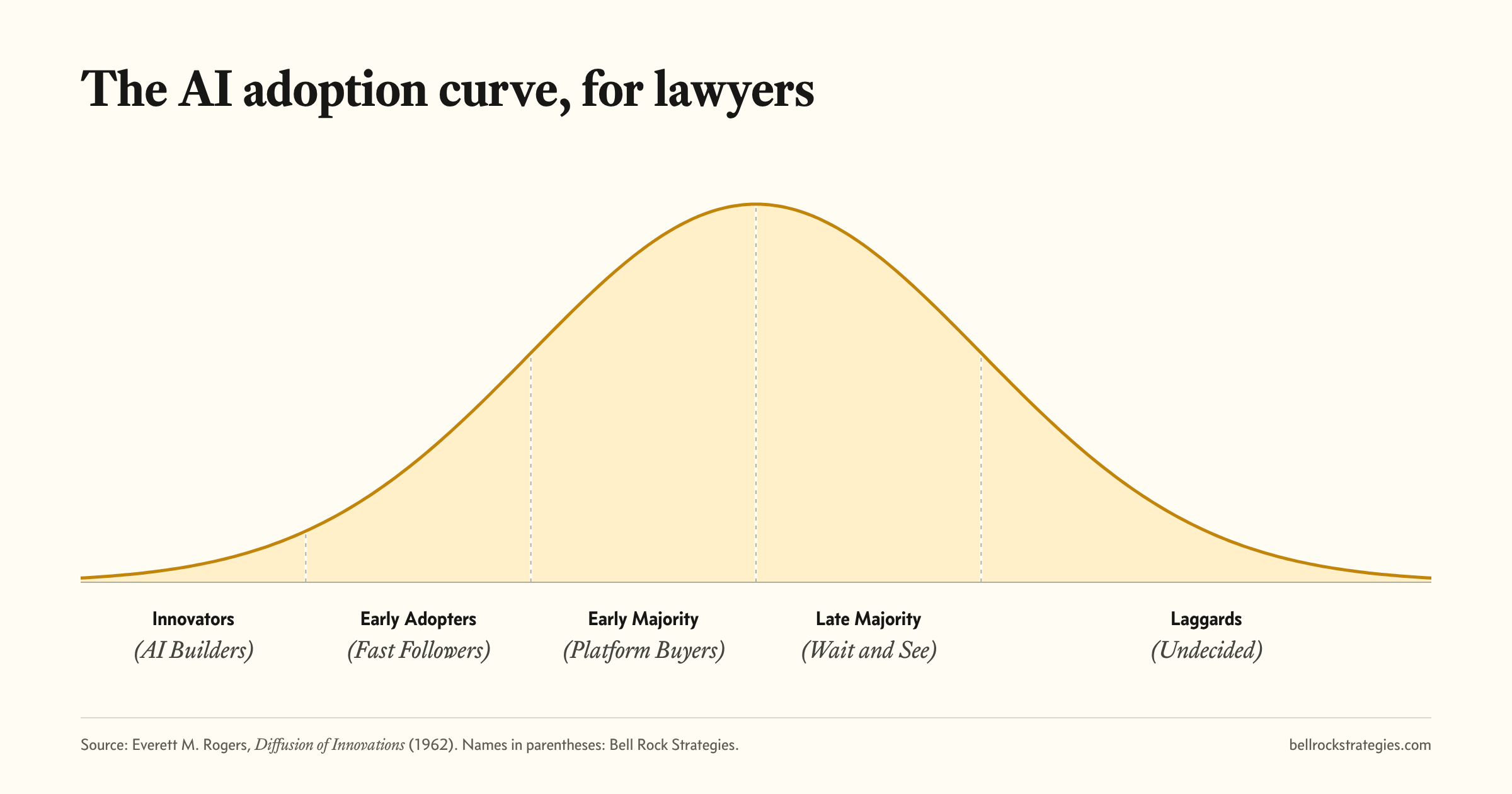
In law, the innovators are building, and have already built, their own AI-first systems. They’ve invested time and money learning how to leverage AI to have full control over how their tools work. By my estimate, that’s around 1% of lawyers today.
Here’s what that investment looks like in practice. I recently watched a product demo for a legal AI product built with robust access to statutes and regulatory material. It’s a cool product. For a lawyer who doesn’t use ChatGPT in a sophisticated way, it’s a much better and safer place to work, because its answers draw on the underlying law and not just the model’s training data. But it doesn’t do much that my own system can’t, and mine is customized to how I work, so I’ll keep using my own. But I only have that choice because I’ve spent a lot of time learning how to build it. Most lawyers aren’t likely to make that investment in the next two years, and products like the one I demoed will have a place in the market for a long time.
Every position on the curve has risks
Early adopters pay with time. Climbing the learning curve takes real hours, and some of what you learn will change as the tools do.
Many firms tell me they want to be fast followers: let others prove the approach, then move quickly. That’s a reasonable strategy, but it requires more than most firms expect. A fast follower still has to understand the technology so they can: customize a platform like Harvey so its results reflect your firm’s work, build and share skills across practice groups, hire engineers and lawyers who build workflows, and rethink pricing and client relationships as the work gets faster (and therefore, cheaper).
Very few of the firms I talk to are actually doing all of this. If your strategy is to buy a platform and rely on the vendor’s training, you’ve made a table-stakes investment in AI, and that puts you in the middle of the curve. (I wrote about choosing that platform in Legal AI or ChatGPT? Five Things to Weigh.)
The middle is a legitimate place to be. It costs less in training, and your firm moves along with the market. It’s also a bet that the technology will spread slowly enough—and that your team will have time to organically upskill—and you won’t fall behind. The risk is that fast follower firms move up or down market and compete for your clients on price and quality of service, and you won’t have the capabilities in-house to answer.
Laggards take less risk in the short term, but a bigger risk over the long term: by the time they move, clients and competitors have already re-set the expectations for how legal work gets done. Making no decision is a decision, too: by default, it puts your firm with the laggards.
Doing nothing moves you toward the back
Cowen is right that this will take time. I don’t expect the profession to be transformed in two years. But the technology is improving quickly, and the firms around you are moving. A firm that aims for the middle without a plan to stay there will drift toward the late majority, because everyone else keeps moving forward.
It’s still early
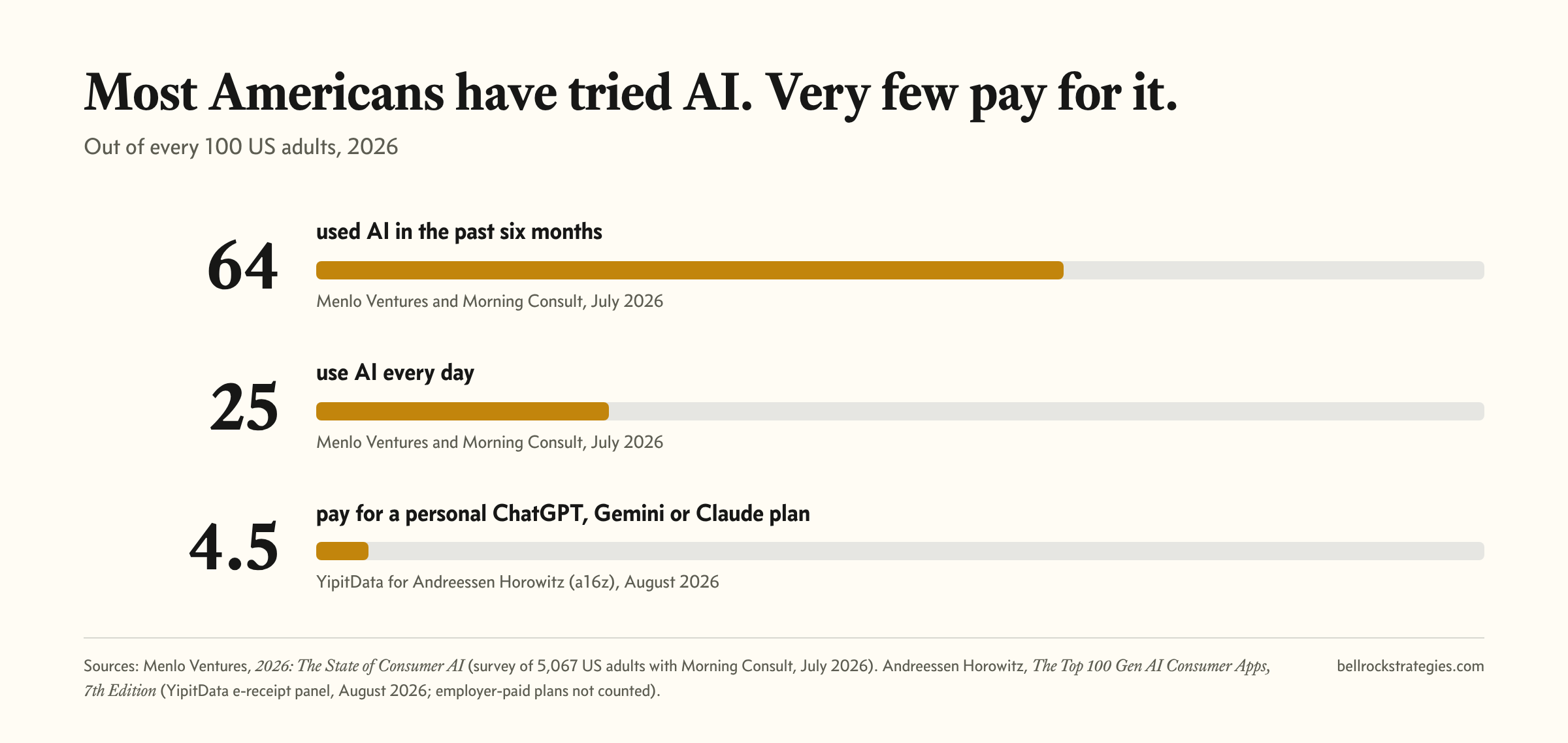
Most Americans have tried AI: 64 in 100 used it in the past six months. Only 25 use it every day, and fewer than 5 pay for ChatGPT, Gemini or Claude. These numbers describe American consumers. The legal industry has its own adoption gap. In 8am’s 2026 Legal Industry Report, 69% of surveyed legal professionals reported using general-purpose AI for work, but only 46% reported that their firms had implemented those tools. Just 28% reported using AI daily, and 54% said their firms offered no AI training and had no plans to. The report was published in March 2026, based on a survey of more than 1,300 U.S. legal professionals conducted in September and October 2025.
If your firm hasn’t started, that’s okay. If you’re willing to invest the time and resources, you can still choose to be an early adopter. But you need to make a deliberate plan. According to an October 2026 Clio report, 85% of surveyed legal professionals report “some level” of AI adoption at their firms (a broad measure). And 52% of surveyed AI users say that losing access would disrupt their work.
Choose a strategy, and be honest about what it takes
Settle on where your firm wants to be on the curve. Then be realistic about what that strategy requires: what training you offer and what you require, what tools you make available to your team, and who you need to hire. (For a starting list, see What Law Firms Should Be Doing About AI Right Now.)
If you want these posts emailed to you every week, subscribe to the Brief, a weekly newsletter for busy lawyers who are curious about AI.